A practical guide for students deciding their next step after degree completion
Finishing college is a big milestone, but it also creates a very common question: what to do after graduation? Whether you completed BCA, BCom, BBA, BSc, BE, BTech or another degree, the next step is not always obvious. Some students want a job immediately, some want higher studies, some want to build practical skills first, and some are still trying to understand which direction fits them best.
The good news is that graduation does not close doors; it opens several paths. The challenge is choosing a path that matches your interests, financial situation, strengths and long-term goals. This article breaks down those options clearly so you can make a sensible decision instead of following confusion, peer pressure or random advice.
Quick takeaway
- After graduation, you can choose higher studies, jobs, internships, certifications, freelancing or government exam preparation.
- The best path depends on what kind of work you want to do and how soon you want to start earning.
- Practical experience often matters more than the degree title alone.
Why students feel confused after graduation
Confusion is normal because graduation is often the first time you are expected to make a major career decision on your own. Until now, the system was mostly structured: school, PU, college, exams, and marks. After that, suddenly, you are expected to think about jobs, salaries, courses, exams, projects, interviews and future growth all at once.
- There are too many options and too little clear guidance.
- Friends and family may suggest different paths.
- Many students do not yet know their strengths.
- College syllabi do not always match industry needs.
- Some students want to earn immediately while others want to study more.
The right answer is not the same for everyone. A BCA graduate and a BCom graduate may end up in different roles, but both can benefit from skill development, internships and realistic career planning.
Popular paths after graduation
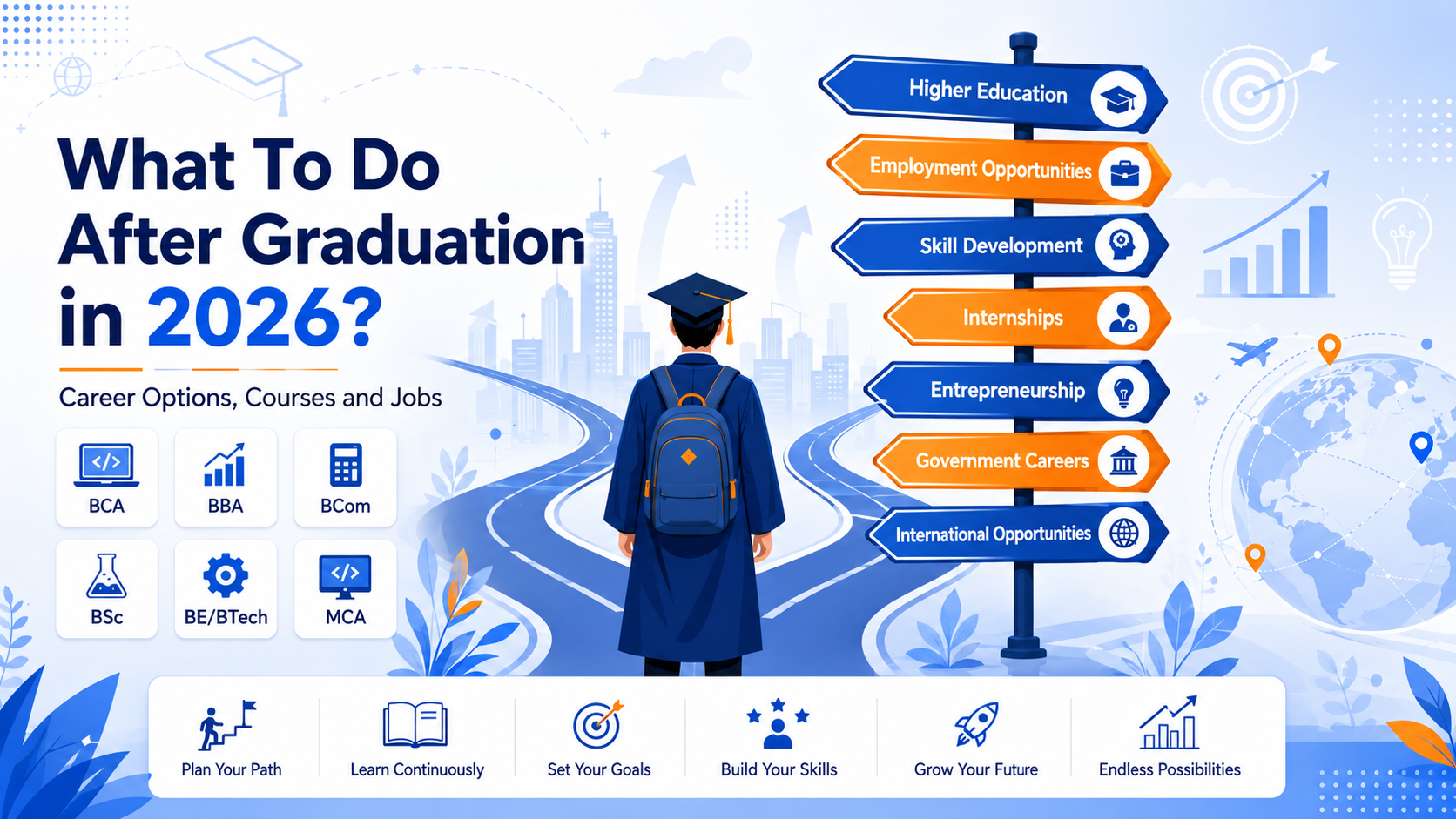
Once you complete your degree, the most common paths fall into six broad categories. Each one has advantages, and each one suits a different kind of student.
1. Higher studies
If you want deeper subject knowledge, stronger qualification value or a specialized career path, higher studies can be the right choice. Examples include MCA, MBA, MSc, MA, MCom, MTech or domain-specific postgraduate diplomas.
2. Direct jobs
Many graduates start working immediately after their degree. Entry-level jobs are available in IT support, development, analytics, finance, sales, operations, administration and digital marketing depending on the background.
3. Skill-based courses
Shorter practical courses are a good choice if you want to become job-ready faster. Full stack development, data analytics, cloud computing, mobile app development and cybersecurity are popular choices among graduates.
4. Internships
Internships help you gain real project exposure before committing to a full-time job. They are especially useful if you do not yet have a strong portfolio or practical work experience.
5. Freelancing or part-time work
Some graduates prefer to work independently while learning. This may include web development, design, content work, digital marketing, video editing, data-related tasks or technical support.
6. Government exam preparation
If you want stable public-sector employment, you can prepare for SSC, banking, railways, state-level exams or other government pathways depending on eligibility and interest.
Option 1: Pursue higher studies
Higher studies make sense when you want to strengthen your academic foundation, qualify for specific roles or delay entering the job market while building deeper expertise. For example, MCA may suit a student from BCA who wants to move further into computer applications, software engineering or academic specialization. MBA may suit a graduate from BCom, BBA or BE who wants to move into management, business roles or analytics. MSc, MCom or MTech may suit students who want subject depth in science, commerce or engineering domains.
Higher studies are valuable when they are chosen with intent. They are less useful when they are chosen only because the student feels uncertain and wants to postpone a career decision. If you decide to study more, it is better to choose a program that matches your future target role.
Option 2: Start working after graduation
Starting a job immediately after graduation is absolutely possible. Many companies hire fresh graduates for entry-level positions if they can demonstrate basic technical ability, communication skills, willingness to learn and a practical mindset. A degree is the starting point, not the final proof of capability.
Graduates who get hired faster usually have one thing in common: they have done something beyond the syllabus. That may be a small project, an internship, a certification, a GitHub portfolio, a presentation, a business case study or a hands-on training program.
Option 3: Build industry skills before applying
This is one of the most practical paths in 2026. If you are not fully ready for a job and do not want to jump into higher studies immediately, spend a few months building a focused skill set. This can make a big difference in how you perform in interviews and how confident you feel when applying.
For students in and around Mangalore, this is often the best balance: stay close to home, learn practical skills, complete projects and then apply for jobs or internships with a stronger profile.
Best career options after graduation
The best career option depends on your background, but several paths are consistently strong for graduates in 2026. Here are some of the most practical ones.
Software Developer
A strong option for graduates who enjoy coding, logic and building applications. This path is common for students from BCA, BSc, BE and BTech backgrounds.
Full Stack Developer
Full stack roles are popular because they allow you to work on both frontend and backend development. Practical training and project work matter a lot here, which is why internship experience is valuable.
Data Analyst
Data analytics is a strong option for graduates from technical, commerce and management backgrounds. It often uses Excel, SQL, Python and visualization tools to turn data into decisions.
Cloud Engineer / Cloud Support Associate
Cloud roles are growing because more companies are shifting infrastructure, deployment and storage to cloud platforms. AWS and Azure basics can help graduates enter this field.
Mobile App Developer
Mobile development is useful for graduates who enjoy creating practical consumer-facing products. Android, React Native and cross-platform development are good entry points.
AI and Machine Learning Roles
AI and ML are attractive areas, especially for graduates who like programming and data-driven work. These roles usually require a strong foundation, so many students begin with a data science or Python-based learning path first.
Cybersecurity Roles
Cybersecurity is a growing field with strong demand across industries. Graduates can move toward security testing, system protection, SOC-related roles or security support, especially after some practical training.
What to do after graduation except higher studies
Not every graduate wants to continue with a master’s degree. If you want an alternative path, you can build career momentum through one or more of the following choices:
- Join a job-oriented course in your preferred domain.
- Complete a practical internship.
- Build a portfolio of projects.
- Learn tools used by employers in real work environments.
- Apply for entry-level positions and continue learning on the job.
- Prepare for competitive exams if public-sector roles are your goal.
This route is often faster and more flexible than formal higher education, especially if your priority is employability.
Skills employers look for in 2026
Across most industries, employers care about a mix of technical ability and workplace readiness. The exact tools differ by role, but the overall expectations are becoming more consistent.
- Technical basics: programming, logic, SQL, data handling, cloud basics or domain-specific tools.
- Problem solving: the ability to break down a task and work through it logically.
- Communication: being able to explain ideas clearly, ask questions and work in teams.
- Adaptability: willingness to learn tools and workflows that are new to you.
- Project exposure: some evidence that you have built or handled something practical.
- Professional attitude: punctuality, reliability and basic workplace discipline.
Career opportunities for graduates in Mangalore
Mangalore is a practical place for graduates who want to start locally. The city has growing opportunities in IT, software support, digital marketing, analytics, operations, finance, administration and startup-related work. For many students, staying in Mangalore for the first step is a smart decision because it allows them to gain experience, build confidence and reduce relocation pressure.
Nearby areas such as Udupi and Dakshina Kannada also have students who benefit from local, mentor-led training before moving into larger markets. A strong local internship can make your resume more competitive whether you apply in Mangalore, Bengaluru or elsewhere.
Local advantage
- Lower living costs than metro cities.
- Better access to nearby mentorship and training.
- Good starting point for internships and early-career jobs.
- Useful for students who want to build confidence before relocating.
Common mistakes graduates make
Mistake 1: Doing nothing for months
Waiting for perfect clarity usually leads to delay. Even a small project or short course is better than remaining inactive.
Mistake 2: Choosing a course only because others chose it
The right path should fit your interests and goals, not your friend's decision.
Mistake 3: Applying for jobs without preparation
If your resume has no projects, internship work or practical proof, it becomes harder to stand out.
Mistake 4: Ignoring skill-building
Degrees matter, but practical skills are often what turn a graduate into a hireable candidate.
How to choose the right path after graduation
- Understand your interests. Ask whether you like coding, business, analysis, design, support work or management.
- Check your timeline. Decide whether you need to earn soon or whether you can spend time studying further.
- Assess your current skill level. Be honest about what you can do now and what still needs work.
- Look at job demand. Choose a direction that has real openings, not just popularity.
- Try before committing. A short internship or focused course can reveal whether a field actually suits you.
FAQ
What should I do after graduation?
You can choose higher studies, a job, an internship, a skill-based course, freelancing or government exam preparation. The right option depends on your goals.
Can I get a job after graduation without higher studies?
Yes. Many graduates start in entry-level roles after building practical skills and some project or internship experience.
What are the best courses after graduation?
Popular options include full stack development, data analytics, cloud computing, mobile app development, cybersecurity, MCA and MBA depending on your background.
Is higher study necessary after graduation?
No. Higher studies are helpful for some students, but not mandatory for everyone.
Are there career opportunities for graduates in Mangalore?
Yes. Mangalore has opportunities in IT, analytics, support, digital marketing, finance, operations and startups, along with practical training options.
How do internships help after graduation?
Internships build practical experience, improve confidence and make your resume stronger for interviews.
Conclusion
There is no single answer to the question of what to do after graduation. Some students should go for higher studies, some should start working, and some should first build industry-ready skills through internships or short courses. What matters is that your choice is intentional, practical and aligned with the life you actually want to build.
If you are a graduate in Mangalore or nearby regions and you want to move from confusion to action, CodeLab Systems can help with practical training and internship-based learning. The goal is not just to finish a course — it is to become confident enough to take the next step in your career.
Build practical experience before your next job
Explore CodeLab Systems internship programs in Full Stack Development, Data Analytics, Data Science, Cloud Computing and Mobile App Development. These programs are designed to help graduates gain real skills and project exposure.
Talk to us about internshipsTags